Tuesday, March 29, 2011

Does the universe split each time a qubit is measured ?

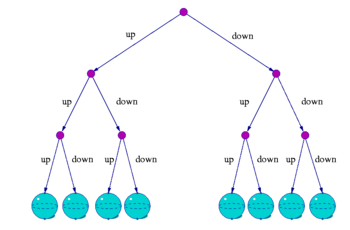
In the Many Worlds Interpretation of quantum mechanics it is thought that when a quantum wave function collapses to give one of the possible quantum outcomes, the universe splits into several universes. In each of those universes a different possible outcome is realized. For instance, assuming that a qubit is measured, its wave function collapses to give either up or down (1 or 0). In the Many Worlds Interpretation, the universe is split into two universes where in the first universe they observe 1 and in the second they observe 0. Check the wikipedia photo:


But, apart from that interpretation, each observation has a certain probability defined by Born's rule. That is, if we repeated the measurement (after re-initializing the quantum system to the same state) a very big number of times, then the fraction of times we observe a certain outcome is roughly equal to its probability.

So, if universe is split each time a qubit is measured into two universes, one where 1 is measured and another where 0 is measured, then how do we interpret probability of measurment ? It might be plausible to assume that the probability should hold relatively to each universe. For instance, for each of this universes, it should observe a probability consistent with the probability given by Born's rule. But since all paths are followed (correct me if I am wrong), then there exists exactly one universe (path) of all these branches (in the multiverse tree) where the measurement always took the same value. This was the obvious case for counter-example. It could also be noted that there would be a lot more universes where the probability isn't necessarily consistent the one given by Born's rule (the exact number -in the case of having two possible outcomes, could be given by $n! - \binom{n}{np}$ where $n$ is the number of measurements and $p$ is the probability of measuring one of the outcomes).

Another thing, if we assume that we could have an countably infinite number of measurements, then according the Many Worlds Interpretation, we will end up with an uncountable infinite number of universes.

Sunday, March 13, 2011

الديموقراطية


لكل واحد فاهم الديموقراطية غلط، الديموقراطية يعني ان رأيي ممكن يكون غير رأيك، ولا تعني ان رأيك هو الصحيح

الديموقراطية تعني حرية الإعتقاد وتعني بالضرورة ان نتقبل فئات أخرى مثل الإشتراكيين والشيوعيين والإخوان والسلفيين والعلمانيين وغيرهم

الديموقراطية تعني ان لا نحجر على فكر ولا نحجر على رأي ولكن ان نناقش ونقدم الأدلة العقلية وغيرها ونترك القرار لصاحبه

الديموقراطية تعني ان رأيي خطأ يحتمل الصواب ورأي غيري صواب يحتمل الخطأ

الديموقراطية تعني ان اتقبل رأي الأغلبية حتى لو اختلف عن رأيي، طالما اوصلت لهم أدلتي ومنطقي قبل التصويت

الديموقراطية هي ان الاختلاف هو الأصل، ان لا استنكر ان رأيك غير رأيي، ان اتقبل منطقك مهما بدا لي غبيا متخلفا ، ثم اناقشك فيه

الديموقراطية، ايضا، هي ان يكون عقلي متفتحاً لآراء اخرى، وان يمكنني تغيير رأيي اذا اقتنعت، بكل سهولة وسلاسة وبدون تمسك وكبرياء

الديموقراطية لا تعني ان نختار ما يخالف شرع الله، بل تعني تطبيق "أنتم أدرى بشئون دنياكم"

الديموقراطية لا تعني ان نحلل ما حرم الله

الديموقراطية لا تعني استبدال شرع الله بل التشاور على ما خيرنا فيه شرع الله

Tuesday, February 22, 2011

Vacuously true

A sentence like $$ \forall a \in A : P(a) $$ is said to be Vacuously true if $A$ is the empty set, no matter what the predicate $P$ was. For example the sentence $$ \forall x \in \mathbb{R}$$ such that $$x^2 < 0 : x = 23 $$ is true (vacuously).

This could be tricky in some cases. An example I found in the exercises of the book Topology 2nd Ed. by Munkres (which is an awesome book btw), showed this sentence and asked if is true or not, if the two sets $A,B$ are guaranteed to be non-empty or not: $$ (A \times B) \subseteq ( C\times D) \implies A \subseteq C \mbox{ and } B \subseteq D $$.

After some time brushing the rust off my brain, this statement turned out to be true (as the intuition would expect) only if $A$ and $B$ are non-empty. Quiet a surprising result. A counter example case occurs when $A$ is empty but $B$ isn't, in which case $ A\times B$ is empty, in which case the statement holds vacuously although $B$ might not be a subset of $D$.

Wednesday, February 16, 2011

voting system

For each registered voter
1- print 2D barcode for the value of an cryptographically authenticated, semantically-secure-encrypted ID of each of the nominees, along with a signature to allow the voter to check if his vote was counted.
2- send to each voting room exactly the number of registered voters to vote in it
3- when a voter votes his video is recorded with a newspaper of the day so that he can't claim later he didn't vote. he is required to leave the encrypted IDs for the nominees he didn't vote for as a proof against him that he didn't vote for anyone other than the one who he did vote for him (while not-revealing to anyone but the central computer)
4- counts is checked for each room
5- after collecting the votes, an automated scanner scans the numbers and sends them to a secured server to check the authentication of each printed encrypted ID and then using homomorphic properties to tally the votes
6- the tally is once decrypted (so only the counts is revealed and privacy of each voter is preserved), the list of signatures of votes counted is kept so that each use can guarantee his vote was counted (zero-knowledge proofs might get involved her as well)

conclusion:
to the end use this is mostly as basic as cutting a piece of paper
only one central computer needed
privacy, authenticity, counting, checking, proofs, is guaranteed